When Sienna Salcedo isn’t working 12-hour shifts three times a week as a physician’s assistant at Bellevue Hospital in New York City, she’s flying down to West Palm Beach or Miami to host Botox parties. On a recent Thursday, Salcedo had a particularly trying day at Bellevue, facilitating difficult goals-of-care conversations with the families of two different patients — one would need life support in order to survive, and the other was suffering from impaired function that would alter the course of his life. When her shift ended, Salcedo had to recalibrate quickly, leaving work and heading straight to the home of a private client who had started to notice a stubborn line on her forehead and was in need of an emergency Botox touch-up.
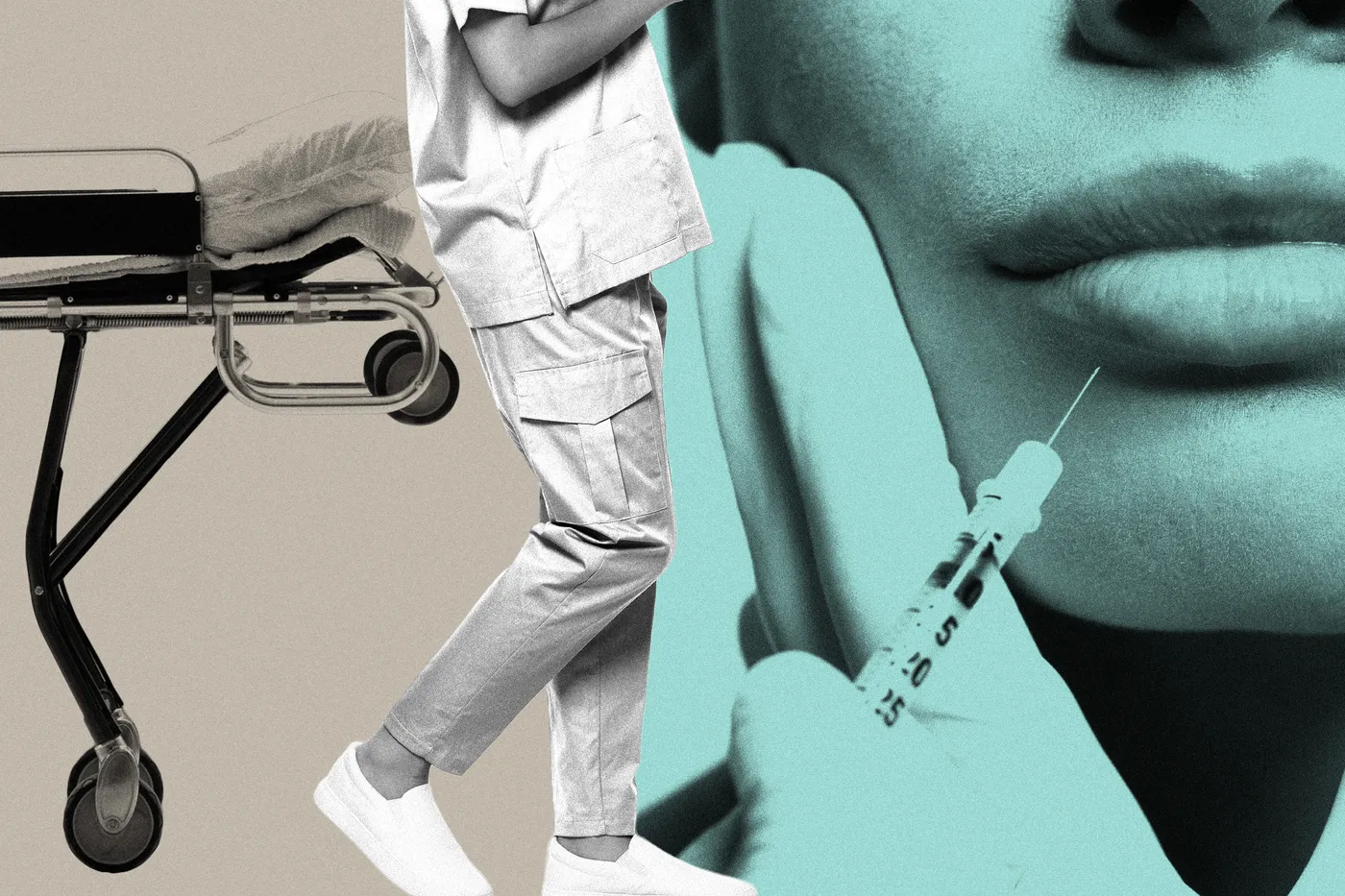
After the injection, Salcedo rushed home to pick up her suitcase filled with supplies — mostly needles and dermal filler, which doesn’t need to be refrigerated — before heading to the airport for her flight to West Palm Beach. She made it with minutes to spare. By Sunday, around 25 plumped faces later, she was home, in time to rewatch an episode of Love Island, before waking up for her morning shift at Bellevue the next day.
“There’s this kind of a contradictory feeling for me, because there’s a big part of me that loves helping people who need it,” says Salcedo of her bifurcated life. “But being self-sufficient and independent as a young woman is very important to me, especially as the child of two immigrant parents.”
Salcedo is part of a greater rash of nurse practitioners, registered nurses, and physician’s assistants who are leaving the hospital system — or bypassing it entirely — for the greener and more autonomous pastures of aesthetics. After a 20-year growth spurt, the number of students in entry-level baccalaureate nursing programs fell by 1.4 percent last year, 9.4 percent in master’s nursing programs, and 4.1 percent in Ph.D nursing programs, according to the American Association of Colleges of Nursing. “In aesthetics, it’s like breathing easy,” says Salcedo. “Because my conversations aren’t: ‘Who’s your health-care proxy?’ It’s more: ‘How was your trip to Greece?’”
This shifting workforce won’t come as a surprise to anyone working in or around the U.S. medical system in the past 50 years. Scholars have warned of a nursing shortage for decades, with many factors at play: A high patient-to-nurse ratio is just one of the many long-standing issues that nurses have faced — a concern that was only exacerbated by the pandemic. According to a 2022 National Nursing Workforce Survey, 50.8 percent of nurses reported feeling emotionally drained, 49.7 percent fatigued, and 45.1 percent burned out.
Sarah Wade, a registered nurse in New York, spent eight years working in the hospital system — first at a pediatric emergency room in Miami and then at the pediatric cardiac ICU at New York Presbyterian in New York — before making the switch to aesthetics. After COVID hit, she started considering a change. “I was still doing nights and I was burned out,” says Wade. “And the kids were so sick … in the ER, there was hope, but in the pediatric cardiac ICU, there was so much less of it.”
Read more here.